

Nine Failed Attempts and One Very Over-it Soapmaker
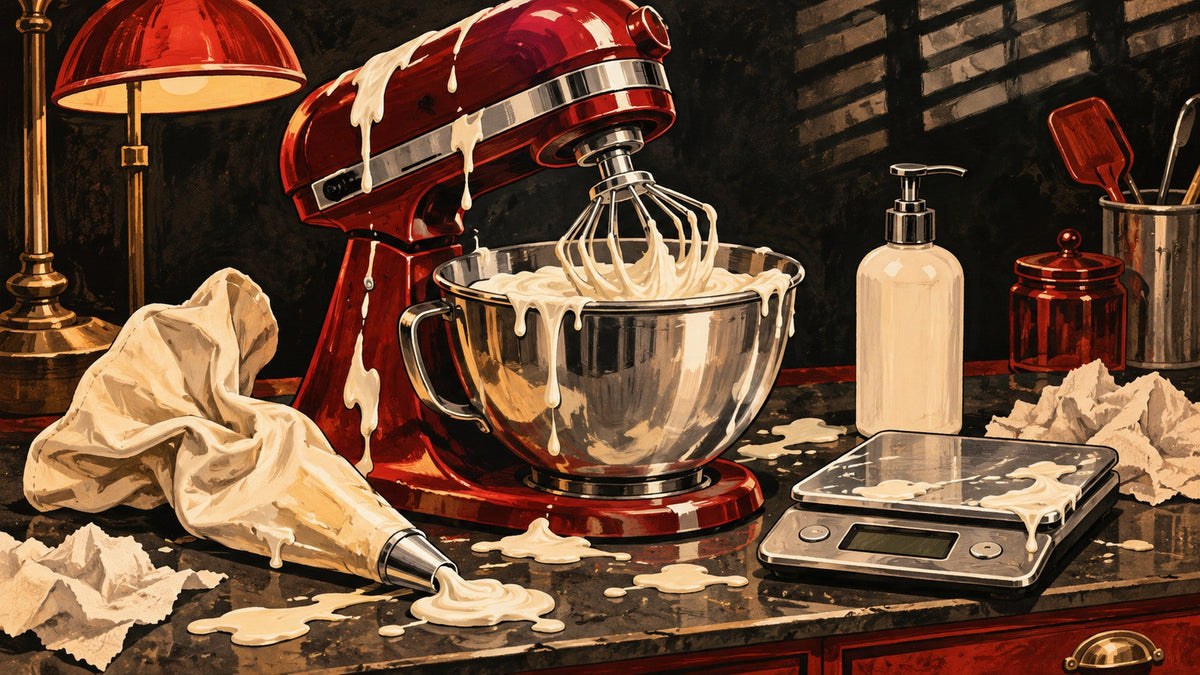
One KitchenAid. One pastry bag. One bottle. One scale. Approximately nine attempts. Zero bottles of lotion filled.
Welcome to The Back Room, where I tell you what goes on behind the scenes at Prohibition Soap. Sometimes that means the chemistry, the ingredients, or the work that goes into making a product. Other times, it means explaining how a grown man managed to lose an entire evening to a bag full of lotion.
This one happened in 2024. And no, there aren't any photographs. My hands were too covered in lotion to operate a phone.
First, a Little Background
Before Prohibition Soap became my full-time job, I worked in the oil industry as a coatings manager. I taught myself the chemistry involved and, with just one other person helping, built an industrial nickel-plating operation. That kind of work teaches you to pay attention to measurements, methods, and what happens when the process doesn't go according to plan.
I started Prohibition Soap in 2020 as a part-time business, went full-time in 2022, and Mama P joined full-time in February 2023. By the time this particular crime against kitchen cleanliness occurred, we'd already been making products together for a while.
Here's how we usually develop something new: I make the first version myself. I want to understand the process, test the quality, and figure out the best way to produce it before we offer it to customers. That means a fair amount of experimenting at night, often after the regular workday is over.
In 2024, it was time to tackle lotion.
The Instructions Made It Sound So Easy
I was working with a concentrated lotion base and distilled water, following the supplier's mixing directions. In theory, it was straightforward: combine the ingredients, get the consistency right, and then transfer the finished lotion into bottles.
I had a KitchenAid mixer. I had the lotion base. I had the water. I had a plan.
What I apparently did not have was a workable system for keeping the lotion in the mixer instead of everywhere else.
The KitchenAid Incident
I put the lotion in the KitchenAid and started mixing. The problem was that lotion does not behave particularly well when your equipment and technique aren't suited to the job. Before long, the stuff was going everywhere.
Onto the work area. Onto whatever happened to be nearby. Onto me.
At some point, I had to accept that I'd made a fairly impressive mess before even reaching the part where the lotion was supposed to go into a container.
But I wasn't giving up yet. The next step was transferring it into bottles, and the instructions had another bright idea waiting for me.
Enter the Pastry Bag From Hell
The suggested method involved loading the lotion into a pointed pastry bag and squeezing it into the bottles.
Sounds reasonable, doesn't it? If you've ever watched somebody pipe frosting, it looks easy enough.
Here's the problem: I'm not frosting a cake. I'm trying to fill a lotion bottle to a specific weight. The bag was collapsing, lotion was spilling, and I was quickly discovering that the instructions made a lot more sense on paper than they did in my hands.
And the bag was only half the problem.
The Scale Was the Final Insult
Picture this: I'm holding the pastry bag with one hand, trying to squeeze lotion out of it. With the other, I'm trying to hold a bottle in place on a scale.
But I can't press down on the bottle, because pressing on the scale changes the reading. I'm supposed to keep the bottle steady, squeeze the bag, control the flow, and somehow avoid putting any extra weight on the scale.
All while the pastry bag is doing its best impression of a wounded animal.
I tried to make it work again and again. Roughly nine attempts later, I still hadn't successfully filled a single bottle.
Not one. I hadn't gotten through the filling stage. I was still fighting the equipment.
One Very "Over-it" Soapmaker
By this point, lotion was everywhere, and I'd had more than enough. Rather than keep burning through paper towels wiping up every bit of spilled lotion, I started rubbing some of it onto my own skin.
There I was, covered in lotion, surrounded by a mess, staring at a filling method that clearly wasn't working for me.
For the record, I hadn't invented some exciting new skin-care application technique. I was just pissed off and trying not to waste any more paper towels.
Eventually, I called it. I quit for the night.
No bottles filled. No triumphant first batch. Just an extremely moisturized soapmaker and a kitchen that looked like the lotion had put up a fight.
Mama P Surveys the Evidence
Mama P was already working with me full-time by then. I explained what happened, and she saw the evidence for herself.
She also knows this isn't exactly a rare occurrence around here. I develop products, I experiment, and sometimes I destroy the kitchen in the process. She's often the one cleaning up after me.
I don't remember her exact reaction that day, and I'm not going to make one up just because it would make a good punch line. I'll just say the mess did a pretty good job of speaking for itself.
Today, Mama P handles much of our lotion production. I'd love to tell you precisely which change finally made the process easier, but that part of the story is hers to tell, and I'll have to ask her.
Why I Still Make the First Batch
It would be easy to tell this story as one big screw-up. To be fair, that's exactly what it was. But it's also part of how we figure things out at Prohibition Soap.
There's a difference between following directions once and developing a process you can repeat reliably. How does the product mix? How do you transfer it into a container? How do you measure it accurately? How much mess are you making along the way? Those practical questions matter just as much as what's written on the ingredient list.
That's why I personally test new products and production methods before they're part of our regular lineup. Sometimes the result is something we're proud to sell. Sometimes the result is a valuable lesson and a kitchen in need of professional intervention.

The Verdict
I've built an industrial nickel-plating operation. I've developed soap and grooming formulas. I've managed equipment that demands real precision.
But in 2024, a KitchenAid, a pastry bag, and a bathroom scale handed me a complete ass-kicking.
That's the truth about making products in a small family business. The polished bottle on the shelf doesn't show the failed attempts, the late nights, or how much trial and error went into getting there.
And sometimes the best thing you can do is quit for the night, clean up the evidence, and figure out a better way tomorrow.
Welcome to The Back Room. There are plenty more stories where this one came from.